Affiliate disclosure: As an Amazon Associate, this site earns from qualifying purchases linked in this article.
DHEA is sold as capsules, loose powder, and sublingual liquid drops, and marketing for each form often claims an absorption edge over the others. The actual pharmacokinetic evidence is more limited, and more nuanced, than the marketing suggests.
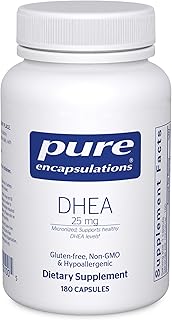
Capsules: The Best-Studied Form
Oral capsules are the form used in the controlled human pharmacokinetic research that exists on DHEA. In a study of postmenopausal women given 50 mg oral DHEA capsules, serum DHEA rose from a baseline of about 2.3 ng/mL to a peak of roughly 15.6 ng/mL within one hour, before declining and plateauing over the following hours[1]. That rapid, well-characterized absorption profile is a real advantage of the capsule form, it’s simply the most measured.
Powder: Same Absorption Path, Different Dosing Precision
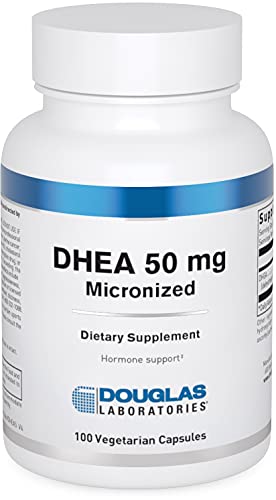
Loose or micronized DHEA powder is absorbed through the same gastrointestinal route as a capsule, since a capsule is essentially powder in a shell. A study comparing micronized and unmicronized oral DHEA in premenopausal women found both forms significantly raised DHEA, DHEA-S, and testosterone levels with no significant difference between them, though the micronized form may modestly reduce conversion to testosterone. The practical tradeoff with powder isn’t absorption, it’s dosing precision: measuring an exact milligram amount by volume is inherently less consistent than a manufactured capsule.
Sublingual Liquid: A Plausible but Unproven Shortcut
Sublingual drops are marketed on the premise that absorbing DHEA through the oral mucosa bypasses first-pass liver metabolism, potentially improving bioavailability. That mechanism is grounded in general sublingual drug-delivery pharmacology, but there is no rigorous, peer-reviewed head-to-head pharmacokinetic study directly comparing sublingual DHEA to oral capsules with the kind of blood-level data available for oral dosing. The claim is plausible, not confirmed.

What the Comparable Data Actually Shows
The one rigorously controlled comparison that does exist is oral capsules versus percutaneous (topical) DHEA, and it found the oral route produces a fast, high peak in serum DHEA within an hour, while the topical route rises much more slowly, reaching comparable levels only after about 24 hours[1]. That study doesn’t include sublingual dosing, but it does confirm that route of administration meaningfully changes the absorption curve, which is the underlying reason people look for alternatives to plain oral capsules in the first place.


Weighing the Three Forms
Capsules remain the form with the most direct human absorption data behind them. Powder offers the same absorption path with more room for dosing error. Sublingual liquid has a plausible rationale but lacks DHEA-specific evidence to confirm it actually outperforms capsules in practice. For most people, the deciding factor should be dosing consistency and third-party testing of the product, not the delivery format.
The Form the Outcome Evidence Was Built On
There is an argument for capsules that goes beyond absorption curves: it is the form behind essentially every clinical outcome attributed to DHEA. The DHEAge study used 50 mg of daily oral DHEA for a year to produce its bone, libido and skin findings[2]. The two-year trial that tested and largely failed to confirm the broader anti-aging claims also used daily oral dosing[3].
This matters when a specialty format claims superiority. Even if a delivery route genuinely produced higher blood levels, the effect sizes people are hoping for were measured on ordinary oral dosing, so a higher peak is not the same thing as a better outcome. Choosing the studied form is the conservative default rather than a compromise.
The Question Powder Actually Raises
The dosing-precision problem with loose powder deserves a sharper statement than it usually gets, because DHEA is potent at small amounts. Common capsule strengths run from 5 mg to 50 mg, and at the low end a measuring error that would be trivial with a gram-scale supplement is a large proportional change in the dose. A kitchen scale cannot resolve the difference between 5 mg and 10 mg reliably.
For anyone deliberately starting low, which is the standard conservative approach, that alone is a strong argument against powder. The scenario where powder makes sense is a dose that is already established, already verified with bloodwork, and large enough that a small absolute measuring error does not matter much.
How to Decide in Practice
A reasonable decision rule, in order: choose the strength that matches your intended dose without splitting, prefer a product with third-party testing, and treat delivery format as a tiebreaker rather than a primary criterion. Product quality is the variable with a documented failure rate in this category, and no delivery format compensates for a product that does not contain what its label says.
The one case for deviating is a genuine practical constraint rather than a pharmacokinetic one. Difficulty swallowing capsules is a real reason to use liquid drops. Wanting a dose between the available capsule strengths is a real reason too. Neither of those is the absorption argument the marketing usually makes, and both are better reasons than it.

References
- Bioavailability and metabolism of oral and percutaneous dehydroepiandrosterone in postmenopausal women. The Journal of Steroid Biochemistry and Molecular Biology, 2007
- Dehydroepiandrosterone (DHEA), DHEA sulfate, and aging: contribution of the DHEAge Study to a sociobiomedical issue. Proceedings of the National Academy of Sciences, 2000
- DHEA in elderly women and DHEA or testosterone in elderly men. The New England Journal of Medicine, 2006
These statements have not been evaluated by the Food and Drug Administration. This information is not intended to diagnose, treat, cure, or prevent any disease. Content is for informational purposes only and is not medical advice; consult a qualified healthcare provider before starting any supplement. As an Amazon Associate we earn from qualifying purchases.