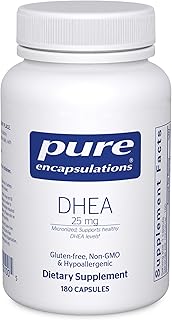
Affiliate disclosure: As an Amazon Associate, this site earns from qualifying purchases linked in this article.
DHEA supplements are sold over the counter in doses ranging from 5 mg to 100 mg, and that range itself is part of the problem for a first-time user: there is no single official “starting dose,” and the bottle size on the shelf is not necessarily the right dose for a given person.
Why Starting Low Matters More Than It Sounds
DHEA is a steroid hormone precursor, not a vitamin, and it converts into androgens and estrogens once in the body[1]. That conversion is what produces both its intended effects and its most common side effects, acne, oily skin, and hair changes, which are dose-dependent and generally reversible by lowering the amount taken[2]. Starting at the lowest end of the range gives a way to see how a given body responds before committing to a higher dose.
What a Realistic Beginner Dose Looks Like
General reference dosing for DHEA supplementation clusters around 25 to 50 mg per day for adults, with condition-specific protocols sometimes starting lower and titrating upward over weeks based on response and lab work rather than jumping straight to a target dose[3]. For someone with no prior DHEA use, starting at the low end of whatever product is on hand, splitting a capsule if needed, is a more conservative approach than taking a full standard-adult dose on day one.

Titrate Based on Response, Not a Fixed Schedule
Because DHEA’s downstream hormone conversion varies by person, age, and sex, the same milligram dose can produce different effects in different people[1]. A practical approach is to hold a starting dose for several weeks, track how skin, sleep, mood, and energy respond, and only increase gradually if there’s no adverse reaction and the intended benefit hasn’t materialized, rather than increasing on a fixed weekly schedule regardless of how the body is responding.
Signs the Starting Dose Was Too High
New or worsening acne, oily skin, unwanted hair growth, or in men, breast tenderness from estrogen conversion, are the most commonly reported early signs of an excessive dose, and they typically resolve once the dose is reduced or stopped[2]. These are not universal, and their absence doesn’t confirm the dose is correct, but their presence is a clear signal to step back down.

When to Loop In a Provider
Anyone with a personal or family history of hormone-sensitive cancer, or with an existing hormonal condition, should not self-titrate DHEA without medical guidance given its steroid-hormone activity[1]. For everyone else, a baseline DHEA-S blood test before starting, and a recheck after a few weeks at a given dose, turns “starting low” from a guess into something that can actually be verified.


What Doses the Trials Actually Used
Anchoring a starting dose to the research is more useful than anchoring it to whatever strength a retailer stocks, and the trial doses are narrower than the shelf range suggests. The DHEAge study used 50 mg of daily oral DHEA for a year in healthy adults aged 60 to 79[4]. A two-year placebo-controlled trial in elderly women and men with low DHEA-S also used daily oral dosing across the full period[5]. Most of the durable findings in this literature sit in that 25 to 50 mg range.
There is one striking exception that is worth knowing about precisely because it should not be copied. A trial of DHEA monotherapy for midlife-onset depression escalated to 450 mg per day for three weeks[6]. That is roughly nine times the usual research dose, was run under close supervision in a research setting for a diagnosed condition, and is not a template for anyone titrating on their own.
Why a Bigger Dose Is Not a Faster Answer
The intuition that a higher dose reveals whether something works sooner does not hold for DHEA, for two reasons. The outcomes with the best support, bone density in particular, were measured over one and two years, so no dose produces a quick verdict on them. And the side effects that make people stop, acne and oily skin, are dose-dependent, so starting high mainly increases the chance of quitting before the question is answered.
The practical consequence is that a low starting dose costs very little. Holding 5 or 10 mg for six to eight weeks delays nothing that was going to resolve faster anyway, and it gives a clean look at how a given body handles the conversion before more is added.
Decide the Stopping Rule Before You Start
The step most often skipped is deciding in advance what would count as this not working. Without that, dose escalation tends to continue by default, because there is always a reason to try a bit more. A stopping rule stated up front, something like “if DHEA-S has risen into range and the symptom I started for has not changed after twelve weeks, this is not the right intervention”, converts an open-ended experiment into one with an end.
Pairing that with the baseline blood test is what makes the whole approach work. A starting number, a stable dose, a defined interval and a pre-committed decision produces an answer. Adjusting the dose whenever the effect is unclear produces months of use with nothing learned.

References
- DHEA. Mayo Clinic
- DHEA Side Effects: Common, Severe, Long Term. Drugs.com
- Dehydroepiandrosterone Uses, Benefits & Dosage. Drugs.com
- Dehydroepiandrosterone (DHEA), DHEA sulfate, and aging: contribution of the DHEAge Study to a sociobiomedical issue. Proceedings of the National Academy of Sciences, 2000
- DHEA in elderly women and DHEA or testosterone in elderly men. The New England Journal of Medicine, 2006
- Dehydroepiandrosterone monotherapy in midlife-onset major and minor depression. Archives of General Psychiatry, 2005
These statements have not been evaluated by the Food and Drug Administration. This information is not intended to diagnose, treat, cure, or prevent any disease. Content is for informational purposes only and is not medical advice; consult a qualified healthcare provider before starting any supplement. As an Amazon Associate we earn from qualifying purchases.