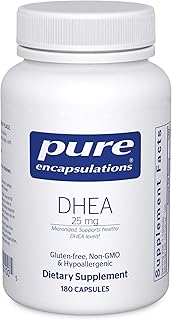
Affiliate disclosure: As an Amazon Associate, this site earns from qualifying purchases linked in this article.
As women navigate midlife and menopause, questions about hormone balance often arise. Dehydroepiandrosterone (DHEA) is a hormone produced by the adrenal glands, and its sulfate form, DHEA-S, is commonly measured in blood tests. While DHEA is available as a supplement, understanding your body’s natural levels can be a helpful first step.
This article explores the role of DHEA-S blood tests, discussing situations where testing might provide valuable information, and emphasizing that such tests are not always a prerequisite for considering supplementation, particularly in the absence of specific medical concerns. It’s crucial to approach any hormonal support with careful consideration and professional guidance.
What is DHEA-S and Why is it Measured?
DHEA is a steroid hormone primarily produced by the adrenal glands. It is a precursor to other hormones, including androgens and estrogens. DHEA-S (dehydroepiandrosterone sulfate) is the sulfated form of DHEA, which is more stable in the bloodstream and therefore more commonly measured in blood tests [1]. Measuring DHEA-S levels can offer insight into adrenal gland function.
Unlike some other hormones, basal serum DHEA-S concentration does not consistently predict the cortisol response to provocative testing, indicating its specific role in adrenal assessment [2]. However, it remains a valuable marker for certain conditions related to adrenal health and hormone balance.
Situations Where a DHEA-S Blood Test Might Be Considered
A DHEA blood test, specifically measuring DHEA-S, can be useful in several scenarios, especially when there are concerns about adrenal function or androgen levels. For instance, in cases of suspected hyperandrogenism, elevated DHEA-S levels can be a diagnostic indicator [1]. This can manifest with symptoms like excess hair growth, acne, or irregular menstrual cycles.

Conditions such as Polycystic Ovary Syndrome (PCOS) often involve hormonal imbalances, including elevated androgens. While DHEA-S is not the sole marker, it can contribute to a broader picture when assessing hyperandrogenism in PCOS [3]. Insulin resistance is also common in PCOS, and treatments like metformin can help reduce hyperinsulinemia and hyperandrogenemia [4].
Conversely, very low DHEA-S levels might suggest adrenal insufficiency, a condition where the adrenal glands do not produce enough hormones [5]. Latent adrenal insufficiency, a less severe form, can also be detected through specific clues and diagnostic approaches [6]. Additionally, primary ovarian insufficiency, a condition where ovaries stop functioning before age 40, can impact overall hormonal balance [7].

DHEA-S Levels and Midlife Women
As women age, DHEA-S levels naturally decline. This decline is part of the broader hormonal shifts experienced during midlife and menopause. While a decline is expected, extremely low levels without other symptoms might warrant further investigation. However, for many women experiencing typical menopausal changes, a DHEA-S test is not always a mandatory first step before considering DHEA support.
Some research explores DHEA supplementation in specific contexts, such as for poor ovarian responders in fertility treatments, where it has been shown to impact follicular fluid metabolome and cytokinome profiles [8]. This highlights that DHEA’s role can be complex and context-dependent.
Interpreting DHEA-S Test Results
Interpreting DHEA-S test results requires careful consideration of individual factors, including age, overall health status, and any existing medical conditions. Normal ranges for DHEA-S can vary by laboratory and age group. A single DHEA-S level should not be interpreted in isolation but rather as part of a comprehensive health assessment.

It’s important to be aware that certain medications or health conditions, such as adjuvant breast cancer treatment, can alter laboratory test results, including hormone levels [9]. Therefore, discussing all current medications and health concerns with a healthcare provider is essential when interpreting any blood test results.
The Role of Testing Before Supplementation
For many women in midlife considering DHEA supplementation, particularly those experiencing common age-related hormonal shifts without specific medical conditions, a DHEA blood test is not always a mandatory prerequisite. The decision to supplement often involves a discussion with a healthcare provider about potential benefits versus risks, individual symptoms, and overall health goals.
However, if there are specific symptoms suggesting adrenal issues, hyperandrogenism, or other hormonal imbalances, a DHEA-S test can provide valuable baseline information. For example, in prepubertal boys with premature adrenarche, DHEA-S levels are often elevated and can be associated with insulin sensitivity and the insulin-like growth factor system [10]. While this example is not directly related to midlife women, it illustrates how DHEA-S levels can be indicative of underlying physiological processes. Ultimately, the decision to test should be made in consultation with a qualified healthcare professional.

References
- Diagnosis of hyperandrogenism: biochemical criteria. Best practice & research. Clinical endocrinology & metabolism, 2006
- Basal serum dehydroepiandrosterone sulphate concentration does not predict the cortisol response to provocative testing. Annals of clinical biochemistry, 1990
- The Cutoff Value of Low Sex Hormone-Binding Globulin and Its Predictive Role in Impaired Glucose Metabolism Among Chinese Women with Polycystic Ovarian Syndrome. Metabolic syndrome and related disorders, 2021
- Metformin therapy in polycystic ovary syndrome reduces hyperinsulinemia, insulin resistance, hyperandrogenemia, and systolic blood pressure, while facilitating normal menses and pregnancy. Metabolism: clinical and experimental, 1994
- [Addison’s disease : Primary adrenal insufficiency]. Der Internist, 2016
- Latent Adrenal Insufficiency: Concept, Clues to Detection, and Diagnosis. Endocrine practice : official journal of the American College of Endocrinology and the American Association of Clinical Endocrinologists, 2018
- Update on primary ovarian insufficiency. Current opinion in endocrinology, diabetes, and obesity, 2015
- Dehydroepiandrosterone supplementation and the impact of follicular fluid metabolome and cytokinome profiles in poor ovarian responders. Journal of ovarian research, 2023
- Alterations in laboratory test results during adjuvant breast cancer treatment. Clinical chemistry and laboratory medicine, 2000
- Insulin sensitivity and the insulin-like growth factor system in prepubertal boys with premature adrenarche. The Journal of clinical endocrinology and metabolism, 2002
These statements have not been evaluated by the Food and Drug Administration. This information is not intended to diagnose, treat, cure, or prevent any disease. Content is for informational purposes only and is not medical advice; consult a qualified healthcare provider before starting any supplement. As an Amazon Associate we earn from qualifying purchases.