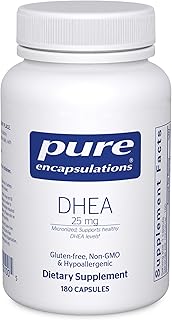
Affiliate disclosure: As an Amazon Associate, this site earns from qualifying purchases linked in this article.
DHEA production begins declining from its mid-20s peak in a steady, age-related pattern, and by the early-to-mid 40s many women are entering the perimenopausal transition where that decline intersects with fluctuating estrogen and progesterone. This is the age range where DHEA supplementation gets discussed most often — and where the evidence, while more supportive than in some other contexts, still comes with real limits worth understanding before starting.
Where the Evidence Is Strongest
A position statement from the Polish Menopause and Andropause Society, reviewing available clinical trials and meta-analyses, concluded that DHEA supplementation is effective specifically in a defined set of situations: women with adrenal insufficiency (including those on chronic glucocorticoid therapy), postmenopausal women with low bone mineral density, premenopausal women with sexual dysfunction and low libido, and women with vulvovaginal atrophy related to menopause[1]. It also noted DHEA is “probably effective” for hypoactive sexual desire disorder, infertility linked to diminished ovarian reserve, and depression/anxiety symptoms — a more qualified tier of evidence than the first group.
Where the Evidence Is Weaker
A separate review of DHEA supplementation for women in the peri- or postmenopausal phase found no clear evidence that DHEA improves general quality of life, and noted some evidence of androgenic side effects (acne, oily skin, unwanted hair growth) associated with use. Whether DHEA meaningfully reduces menopausal symptoms overall was described as uncertain, though there was some support for a modest improvement in sexual function compared with placebo[2]. This is an important balance to the more optimistic framing sometimes seen in supplement marketing: DHEA is not a broad-spectrum menopause symptom fix, even where it does show real effects in narrower areas.

What to Realistically Expect at This Age
For a woman in her 40s starting DHEA, the most evidence-backed reasons to consider it are targeted: low libido or sexual dysfunction, vulvovaginal dryness (where intravaginal DHEA/prasterone formulations have the strongest, FDA-recognized evidence base), or diagnosed low DHEA-S on bloodwork alongside symptoms of adrenal fatigue. General hopes for improved energy, mood, or overall menopause symptom relief are less consistently supported and should be treated as a possibility to monitor for, not a guarantee.

Safety Considerations
Because DHEA converts into both estrogen and testosterone, women with a personal or strong family history of hormone-sensitive cancers (breast, ovarian, uterine) should discuss DHEA with an oncologist or gynecologist before use, not just a general practitioner. Baseline and follow-up bloodwork (DHEA-S, and often a broader hormone panel) is the standard way to track both effect and any androgenic side effects developing over time.


The Vaginal Route Is Where the Evidence Is Strongest, and Also Contested
Intravaginal DHEA deserves its own treatment, because it is both the best-supported use and a good illustration of how effect size and statistical significance can come apart. A 2026 systematic review and meta-analysis pooling five unique randomised trials in 1,611 postmenopausal women found significant improvements against placebo for vaginal dryness, with a mean difference of -0.23, and for dyspareunia, with a mean difference of -0.40, with adverse effects described as mild and infrequent[3].
A critical appraisal of the same literature reaches a more sceptical reading. It notes that in two trials of 255 and 558 women, placebo alone produced roughly a 1-point reduction in dyspareunia on a 3-point scale, with nightly DHEA adding about 0.4 points on top; and that in 464 women with gynaecological cancer, plain moisturiser gel produced a 1.5-point reduction with DHEA adding 0.3. Those primary outcome measures are unvalidated, and the trials excluded women on systemic HRT and applied to postmenopausal rather than perimenopausal women[4].
Both readings are defensible from the same data, and holding them together is more useful than picking one. Intravaginal DHEA works, the improvement over placebo is real but modest, and much of the total benefit women report in these trials comes from the vehicle rather than the hormone. Earlier reviews also found it at least as effective as vaginal estrogen for these symptoms, which makes it a genuine option rather than a first-line necessity[5].
What the Systemic Evidence Says About Everything Else
For oral DHEA taken systemically, the picture is considerably thinner, and two findings are worth knowing before starting. A meta-analysis of ten randomised placebo-controlled trials in women with adrenal insufficiency, the population with the strongest physiological case for replacement, found only a small improvement in health-related quality of life, with an effect size of 0.21, and a small benefit for depression, with no significant effect on anxiety or sexual well-being. Its own conclusion was that the evidence is insufficient to support routine use even in that group[6].
A separate two-year placebo-controlled trial in elderly women and men found no physiologically relevant benefit on body composition, physical performance, insulin sensitivity or quality of life, with the single positive result in women being bone mineral density at the ultradistal radius[7]. Neither trial studied women in their forties specifically, which is a genuine gap, but both point the same direction: systemic DHEA is not a general-purpose intervention.

A Realistic Way to Decide
Put together, this supports a narrow and specific decision process rather than a general recommendation. The strongest case is a defined symptom with a matching delivery route, most clearly vaginal dryness or dyspareunia treated with an intravaginal formulation. The next tier is a documented low DHEA-S alongside symptoms, discussed with a clinician. General hopes for energy, mood or overall menopause symptom relief sit outside what the evidence currently supports.
It is also worth naming what the age bracket does not settle. Being over 40 is not itself an indication, because DHEA-S declines in everyone and a level that is low relative to a 25-year-old may be entirely normal for the age. That is precisely why the baseline blood test matters more here than the birthday does.
References
- Supplementation of dehydroepiandrosterone (DHEA) in pre- and postmenopausal women – position statement of expert panel of the Polish Menopause and Andropause Society. Ginekologia Polska, 2020
- Dehydroepiandrosterone for women in the peri- or postmenopausal phase. Cochrane Database of Systematic Reviews, 2015
- Intravaginal dehydroepiandrosterone for the treatment of vulvovaginal atrophy: a systematic review and meta-analysis. Menopause, 2026
- Intravaginal dehydroepiandrosterone for genitourinary symptoms of the menopause: Is the evidence sufficient?. Post Reproductive Health, 2022
- Efficacy of intravaginal dehydroepiandrosterone (DHEA) for symptomatic women in the peri- or postmenopausal phase. Maturitas, 2018
- A systematic review and meta-analysis of randomized placebo-controlled trials of DHEA treatment effects on quality of life in women with adrenal insufficiency. The Journal of Clinical Endocrinology & Metabolism, 2009
- DHEA in elderly women and DHEA or testosterone in elderly men. The New England Journal of Medicine, 2006
These statements have not been evaluated by the Food and Drug Administration. This information is not intended to diagnose, treat, cure, or prevent any disease. Content is for informational purposes only and is not medical advice; consult a qualified healthcare provider before starting any supplement. As an Amazon Associate we earn from qualifying purchases.