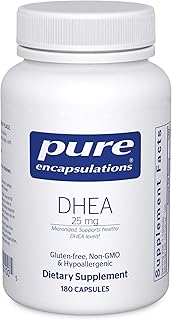
Affiliate disclosure: As an Amazon Associate, this site earns from qualifying purchases linked in this article.
Perimenopause, the transitional phase leading to menopause, often brings a variety of physiological changes, including shifts in body composition and metabolism. Many women report experiencing weight gain during this time, particularly around the abdomen.
Given these changes, interest has grown in understanding how various hormones, including dehydroepiandrosterone (DHEA), might influence weight management during perimenopause. This article explores the current scientific understanding, acknowledging that evidence linking DHEA directly to weight changes in perimenopause is limited.
Understanding DHEA: A Brief Overview
Dehydroepiandrosterone (DHEA) is a steroid hormone naturally produced by the adrenal glands, gonads, and brain. It serves as a precursor to other hormones, including androgens and estrogens [1]. DHEA levels naturally fluctuate throughout life, peaking in young adulthood and gradually declining with age [2]. This age-related decline has led to speculation about its potential role in various age-related changes.
DHEA has been studied for a range of potential pharmacological effects [1]. However, it is important to note that while DHEA is naturally occurring, its use as a supplement is distinct from its endogenous production. The effects of supplemental DHEA are an active area of research.

Weight Changes During Perimenopause
Weight gain is a common concern for women navigating perimenopause. While various factors can contribute to weight changes, including dietary habits and physical activity, hormonal shifts characteristic of perimenopause are also thought to play a role.

For instance, changes in estrogen levels during perimenopause may influence fat distribution, potentially leading to an increase in visceral fat around the abdomen. While research on weight gain during specific life stages like pregnancy is well-documented [3][4], the precise mechanisms behind perimenopausal weight changes are complex and multifaceted, involving hormonal shifts, metabolic rate changes, and lifestyle factors.
The Limited Evidence: DHEA and Weight in Perimenopause
When considering the relationship between DHEA and weight management specifically during perimenopause, the available scientific evidence is limited. While DHEA has been investigated for various potential applications [1], direct and robust studies specifically linking DHEA supplementation to significant weight management benefits for women in perimenopause are not widely established.
Some research has explored DHEA in broader contexts, such as its association with mortality [5] or its role in conditions like Alzheimer’s disease [6]. However, these studies do not directly address weight management in perimenopausal women. Similarly, research on DHEA in relation to physical exercise [7] or specific health conditions like breast cancer [8] does not provide direct evidence for its impact on perimenopausal weight changes.


It is crucial to emphasize that the current body of evidence does not firmly establish DHEA as an effective intervention for weight management during perimenopause. Any potential links are speculative and require much more dedicated research.
Factors Influencing Weight Beyond Hormones
While hormonal changes are relevant during perimenopause, it is important to remember that weight management is influenced by a multitude of factors. Dietary choices, particularly the consumption of ultra-processed foods, have been linked to weight gain and associated health risks [9].
Regular physical activity, sleep quality, stress management, and overall lifestyle habits all play significant roles in maintaining a healthy weight. Focusing solely on hormonal interventions without considering these broader lifestyle aspects may not yield desired outcomes. For instance, weight gain can also be associated with certain medications, such as antiretroviral therapy [10], highlighting the diverse causes of changes in body weight.
References
- Dehydroepiandrosterone (DHEA): Pharmacological Effects and Potential Therapeutic Application. Mini reviews in medicinal chemistry, 2023
- [Dehydroepiandrosterone (DHEA)–youth hormone?]. Wiadomosci lekarskie (Warsaw, Poland : 1960), 2001
- Weight gain during pregnancy: A narrative review on the recent evidences. Diabetes research and clinical practice, 2022
- Weight Gain and Nutrition during Pregnancy: An Analysis of Clinical Practice Guidelines in the Asia-Pacific Region. Nutrients, 2022
- DHEA and mortality: what is the nature of the association?. The Journal of steroid biochemistry and molecular biology, 2015
- Dehydroepiandrosterone (DHEA) and its Sulphate (DHEAS) in Alzheimer’s Disease. Current Alzheimer research, 2020
- DHEA, physical exercise and doping. The Journal of steroid biochemistry and molecular biology, 2015
- Dehydroepiandrosterone (DHEA) in relation to breast cancer. Vitamins and hormones, 2025
- Ultra-processed Foods, Weight Gain, and Co-morbidity Risk. Current obesity reports, 2022
- Weight Gain and Antiretroviral Therapy. Infectious disease clinics of North America, 2024
These statements have not been evaluated by the Food and Drug Administration. This information is not intended to diagnose, treat, cure, or prevent any disease. Content is for informational purposes only and is not medical advice; consult a qualified healthcare provider before starting any supplement. As an Amazon Associate we earn from qualifying purchases.