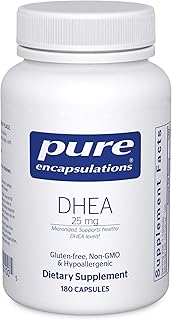
Affiliate disclosure: As an Amazon Associate, this site earns from qualifying purchases linked in this article.
Navigating DHEA supplementation can involve questions about appropriate dosages, especially for women in midlife and menopause. DHEA (dehydroepiandrosterone) is a naturally occurring steroid hormone that the body can convert into other hormones, including androgens and estrogens.
Finding an appropriate DHEA starting dose is a common consideration for individuals exploring this supplement. This article aims to provide an evidence-based overview to help you understand potential starting points, always emphasizing the importance of individualized guidance from a healthcare professional.
Who Should Not Take DHEA
Before a starting dose is relevant, it is worth settling whether DHEA is appropriate at all. Because DHEA is a precursor that the body converts into both androgens and estrogens, several groups are generally advised against supplementing with it, and for some of them the advice is to avoid it rather than to begin at a lower amount.
- A personal or strong family history of hormone-sensitive cancer. Women with a history of breast, ovarian or uterine cancer are generally advised to avoid DHEA, or to use it only under stringent supervision from an oncology team.
- Conditions involving androgen excess. Polycystic ovary syndrome is the common example. Adding a hormone precursor to a body already producing surplus androgens is generally not recommended.
- Reduced liver function. The liver is involved in processing DHEA and its metabolites, so impaired liver function can change how supplementation behaves.
- Pregnancy and breastfeeding. DHEA is not recommended during either.
- A previous reaction to DHEA or to the inactive ingredients in a given product.
That list is a first filter rather than a complete one. The fuller treatment, including how each of these interacts with perimenopause specifically, is in our guide to DHEA contraindications for women. If any of them applies to you, the question worth bringing to a clinician is whether to take DHEA at all, which is a different question from how much to take.
What is DHEA and Why Might Women Consider it?
DHEA is a precursor hormone produced primarily by the adrenal glands. It serves as a building block for other steroid hormones, including androgens (like testosterone) and estrogens [1]. As women age, DHEA levels naturally decline, often beginning in their late 20s or early 30s and continuing throughout midlife and menopause.
The potential roles of DHEA are diverse, given its ability to convert into various active hormones. For instance, DHEA has been explored in contexts such as diminished ovarian reserve, where supplementation has shown promise in improving clinical outcomes in some studies [2]. Its involvement in hormone pathways suggests it may influence a range of physiological processes that are relevant to women in midlife.
General Considerations for DHEA Starting Dose
When considering a DHEA starting dose, it’s important to recognize that a “one-size-fits-all” approach is generally not appropriate. The optimal dose can vary based on individual factors, including age, specific health considerations, and desired outcomes. For systemic effects, DHEA is often administered orally [3].


Some research suggests that DHEA supplementation can lead to increased levels of androgens and estrogens, depending on the dosage and individual metabolism. For example, a position statement from the Latin American Association of Gynecological Endocrinology (ALEG) discusses androgen therapy in midlife and older women, highlighting the careful consideration of dosing [4].
DHEA Dosing in Specific Research Contexts
In the context of diminished ovarian reserve, studies have investigated DHEA supplementation. For example, a systematic review and network meta-analysis on adjuvant treatment strategies in ovarian stimulation for poor responders undergoing IVF included DHEA and noted its use in improving outcomes [5]. Another study specifically on diminished ovarian reserve found that DHEA supplementation improved clinical and in silico markers [2]. While these studies provide insights into dosages used in specific research settings, they do not constitute general dosing recommendations.
It’s also worth noting that DHEA has been studied for various potential roles beyond reproductive health. For instance, sex steroids, which DHEA can convert into, have been investigated for their ability to block the initiation of atherosclerosis [6]. These diverse research areas underscore the complex nature of DHEA’s actions and the need for tailored approaches to supplementation.
Typical Starting Dose Ranges and Considerations for Women
In practice, DHEA starting doses for women often fall within a range, with lower doses typically recommended initially to assess individual response. Some general guidelines suggest starting with very low doses, such as 5-10 mg daily, and gradually increasing if needed and tolerated, under the guidance of a healthcare professional. This cautious approach allows for monitoring of potential effects and adjustments.

It’s important to understand that DHEA is available in various forms and strengths, and the bioavailability can differ. Oral administration is a common route for systemic effects [3]. Monitoring DHEA and its metabolites, such as DHEA-S (DHEA sulfate), along with other hormone levels, can help guide dose adjustments and ensure that levels remain within a physiological range, rather than exceeding them. This personalized monitoring is crucial for optimizing potential benefits while minimizing potential unwanted effects.
Monitoring and Adjusting Your DHEA Dose
Once a DHEA starting dose is established, monitoring is an important step. This typically involves blood tests to measure DHEA-S levels, and sometimes other hormone levels, at regular intervals. The goal of monitoring is to ensure that DHEA levels are within a desired range and to identify any potential imbalances or adverse effects. A healthcare provider can interpret these results in the context of your overall health and symptoms.

Adjusting the DHEA dose, whether increasing or decreasing it, should always be done in consultation with a healthcare professional. Factors such as changes in symptoms, blood test results, and the emergence of any new health conditions can all influence dose adjustments. The slow and steady approach to dose modification is generally favored to allow the body to adapt and to more clearly identify the effects of the supplementation.

References
- Prasterone. American journal of health-system pharmacy : AJHP : official journal of the American Society of Health-System Pharmacists, 2006
- Dehydroepiandrosterone supplementation improves diminished ovarian reserve clinical and in silico studies. Steroids, 2024
- Postmenopausal Hormone Therapy-Local and Systemic: A Pharmacologic Perspective. Journal of clinical pharmacology, 2020
- Androgen therapy in midlife and older women: a position statement of the Latin American Association of Gynecological Endocrinology (ALEG). Climacteric : the journal of the International Menopause Society, 2025
- Adjuvant treatment strategies in ovarian stimulation for poor responders undergoing IVF: a systematic review and network meta-analysis. Human reproduction update, 2020
- Sex Steroids Block the Initiation of Atherosclerosis. Reproductive sciences (Thousand Oaks, Calif.), 2016
These statements have not been evaluated by the Food and Drug Administration. This information is not intended to diagnose, treat, cure, or prevent any disease. Content is for informational purposes only and is not medical advice; consult a qualified healthcare provider before starting any supplement. As an Amazon Associate we earn from qualifying purchases.