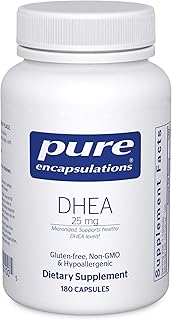
Affiliate disclosure: As an Amazon Associate, this site earns from qualifying purchases linked in this article.
As women navigate midlife and the menopausal transition, changes in hormone levels are a natural part of this journey. While DHEA (dehydroepiandrosterone) is often discussed, it’s one of several steroid hormones that play interconnected roles in the body. Understanding how DHEA relates to other hormone precursors, such as pregnenolone and progesterone, can offer a broader perspective on hormonal changes.
This article explores the current understanding of DHEA, pregnenolone, and progesterone, particularly their potential interactions and relevance for women experiencing hormonal shifts. It’s important to note that research in this area is ongoing, and the evidence regarding the combined use of these hormone precursors is limited.
Understanding DHEA: A Foundational Hormone Precursor
DHEA is a steroid hormone produced primarily by the adrenal glands, with some production also occurring in the ovaries [1]. It serves as a precursor to other hormones, including estrogens and androgens. Levels of DHEA naturally decline with age, a trend that becomes more pronounced during the menopausal transition [2].
The decline in DHEA during midlife is part of the broader hormonal shifts experienced by women. While DHEA is often explored for its potential impact on various aspects of health during menopause, its role is part of a complex endocrine system where multiple hormones interact.
Research into DHEA continues to explore its potential effects on areas such as bone health, body composition, and overall well-being in menopausal women, though the evidence for many of these applications is still developing [3].

Pregnenolone: The ‘Grandparent’ Hormone
Pregnenolone is often referred to as the ‘grandparent’ hormone because it is the initial steroid hormone synthesized from cholesterol in the body. From pregnenolone, the body can then synthesize DHEA, progesterone, and other steroid hormones, making it a crucial starting point in the steroidogenesis pathway [4].
Similar to DHEA, pregnenolone levels can also change with age. Some research has explored pregnenolone’s potential roles in the central nervous system, with one study indicating that pregnenolone sulfate may increase intracellular calcium levels in a pituitary cell line [5]. However, the broader implications of pregnenolone supplementation in women, especially in combination with DHEA, are not well-established.

The interaction of pregnenolone with other hormones is intricate. For instance, profiles of serum neuroactive steroids, which include pregnenolone, have been observed to be altered in certain conditions, highlighting its involvement in complex physiological processes [6].
Progesterone: A Key Female Hormone
Progesterone is a vital female reproductive hormone primarily produced by the ovaries after ovulation, and by the adrenal glands in smaller amounts [7]. Its levels fluctuate throughout the menstrual cycle and decline significantly during perimenopause and menopause as ovarian function diminishes [2].
Progesterone plays a crucial role in regulating the menstrual cycle and supporting pregnancy. Beyond reproduction, it has diverse effects throughout the body. The interaction between progesterone and other hormones, such as estradiol, is well-documented in ovarian function [7].
During the menopausal transition, the drop in progesterone, alongside estrogen, contributes to many of the symptoms women experience. While DHEA is a precursor to a range of hormones, progesterone is synthesized directly from pregnenolone in the steroidogenesis pathway, illustrating their interconnectedness.
The Interplay of DHEA, Pregnenolone, and Progesterone
The steroid hormone pathway illustrates how DHEA, pregnenolone, and progesterone are all interconnected. Pregnenolone is synthesized first, from which both DHEA and progesterone can be produced. DHEA then serves as a precursor for other hormones, including estrogens and androgens. This intricate web means that changes in one hormone precursor can potentially influence the levels of others.

During the menopausal transition, the ovarian-adrenal interactions become particularly relevant as ovarian hormone production declines [1]. This period involves significant shifts in the balance of these hormones. For instance, hormonal changes during menopause can influence various systems, including those related to cognitive function and mood [8].
While these hormones are metabolically linked, the effects of supplementing with DHEA, pregnenolone, or progesterone, either individually or in combination, are distinct and not fully understood. Research often focuses on individual hormones, and studies specifically examining the combined effects of DHEA, pregnenolone, and progesterone in midlife women are limited. For example, while hormonal changes are associated with conditions like sarcopenia in menopausal women, specific management strategies involving combinations of these precursors are still being explored [3].
Considerations for Women in Midlife
For women navigating midlife and menopause, understanding the roles of DHEA, pregnenolone, and progesterone can be insightful. The decline in these hormones is a natural process, but the extent to which supplementing with precursors might support well-being is an area of ongoing research.
It’s important to recognize that hormonal balance is delicate. Factors beyond supplementation, such as lifestyle and diet, can also influence hormone levels. For instance, dietary interventions like time-restricted eating have been shown to affect sex hormone levels in both premenopausal and postmenopausal females [9].
Given the limited evidence on the combined use of DHEA, pregnenolone, and progesterone, particularly in midlife women, any decisions regarding supplementation should be made with careful consideration and professional guidance. The body’s hormonal system is complex, and individual responses can vary significantly.
References
- Ovarian adrenal interactions during the menopausal transition. Minerva ginecologica, 2013
- Hormonal changes in the menopause transition. Recent progress in hormone research, 2002
- Sarcopenia in Menopausal Women: Prevalence, Risk Factors, Hormonal Mechanisms, and Management Strategies. Journal of mid-life health, 2025
- Chronobiologic dynamics of delta 5-3 beta-hydroxysteroids and glucocorticoids in rat brain and plasma and human plasma. Progress in clinical and biological research, 1987
- Pregnenolone sulfate increases intracellular Ca2+ levels in a pituitary cell line. European journal of pharmacology, 1996
- Altered profiles of serum neuroactive steroids in premenopausal women treated for alcohol addiction. Steroids, 2005
- Interaction of 17 beta-estradiol and progesterone production in human granulosa-luteal cells. European journal of obstetrics, gynecology, and reproductive biology, 1990
- Sex hormones and their impact on dementia and depression: a clinical perspective. Expert opinion on pharmacotherapy, 2001
- Effect of time-restricted eating on sex hormone levels in premenopausal and postmenopausal females. Obesity (Silver Spring, Md.), 2023
These statements have not been evaluated by the Food and Drug Administration. This information is not intended to diagnose, treat, cure, or prevent any disease. Content is for informational purposes only and is not medical advice; consult a qualified healthcare provider before starting any supplement. As an Amazon Associate we earn from qualifying purchases.