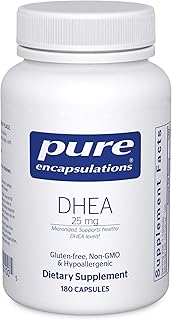
Affiliate disclosure: As an Amazon Associate, this site earns from qualifying purchases linked in this article.
As women navigate midlife and menopause, various hormonal changes can occur. Some individuals may consider DHEA (dehydroepiandrosterone) supplementation. While DHEA is a naturally occurring hormone, supplementing with it can introduce changes to the body’s hormonal balance.
Understanding the potential DHEA side effects in women is important for informed decision-making. This article explores some of the commonly reported side effects, such as skin changes and hair growth, based on available evidence.
Understanding DHEA and its Hormonal Role
DHEA is a steroid hormone produced primarily by the adrenal glands, and to a lesser extent, by the ovaries and brain. It serves as a precursor to other hormones, including androgens (like testosterone) and estrogens [1]. Because of this role, DHEA supplementation can influence the levels of these downstream hormones in the body.
The impact of DHEA on hormone levels can vary depending on the dosage, individual metabolism, and other factors. Changes in androgen levels, in particular, are often linked to some of the observed DHEA side effects in women [2].

Acne and Oily Skin
One of the most frequently reported DHEA side effects in women is the development or worsening of acne and oily skin. This is thought to be related to DHEA’s conversion into androgens, which can stimulate sebum production in the skin [3]. Increased sebum can clog pores and contribute to acne breakouts [4].
The occurrence and severity of acne can depend on the DHEA dosage and individual sensitivity to androgenic effects. Some women may experience mild increases in oiliness, while others might develop more noticeable acne. It’s a common concern when androgen levels become elevated [2].

Unwanted Hair Growth (Hirsutism)
Another potential DHEA side effect in women is hirsutism, which is the growth of coarse, dark hair in areas where men typically grow hair, such as the upper lip, chin, chest, or abdomen. Like acne, hirsutism is often associated with increased androgen levels in the body [2].
Since DHEA can convert into androgens, it has the potential to contribute to unwanted hair growth in some women. The degree of hirsutism can vary, and it’s a factor that individuals considering DHEA should be aware of, especially if they are sensitive to androgenic effects.
It’s important to distinguish hirsutism from general hair thinning or loss, which are different concerns. Hirsutism specifically refers to the growth of terminal hair in androgen-sensitive areas [2].
Hair Thinning and Scalp Changes
While hirsutism relates to unwanted hair growth, some women may also experience changes in scalp hair, such as thinning. The relationship between DHEA and scalp hair can be complex. High levels of androgens, which DHEA can convert into, are sometimes linked to androgenetic alopecia (pattern hair loss) in genetically predisposed individuals.
However, DHEA’s impact on scalp hair is not always straightforward and can depend on individual hormonal balance and other factors. If scalp hair changes are observed, it’s prudent to consider whether DHEA supplementation might be a contributing factor.

Voice Deepening and Other Androgenic Effects
Less common, but possible, DHEA side effects in women related to increased androgenic activity include a deepening of the voice. This is a more significant androgenic effect and suggests a substantial shift in hormone balance. Other potential androgenic changes could include clitoral enlargement, though this is also considered less common with typical DHEA supplementation.
These more pronounced androgenic effects are generally associated with higher DHEA dosages or prolonged use, leading to sustained elevated androgen levels. Monitoring for such changes is important when using DHEA [1].
Other Potential Considerations
While local DHEA (prasterone) vaginal inserts are used to support vaginal health and address symptoms of genitourinary syndrome of menopause (GSM), and are generally associated with minimal systemic absorption and few systemic side effects, oral DHEA can have broader systemic effects [5][6][7].
There can be other individual responses to DHEA supplementation that are not strictly androgenic. These might include mood changes, gastrointestinal upset, or effects on cholesterol levels, although the evidence base for these effects with typical dosages in women is less consistently reported compared to androgenic side effects. The overall safety profile and potential for side effects can also depend on the specific formulation and dosage of DHEA used [1].
References
- Should Dehydroepiandrosterone Be Administered to Women?. The Journal of clinical endocrinology and metabolism, 2022
- Postmenopausal hyperandrogenism. Climacteric : the journal of the International Menopause Society, 2022
- Androgens and antiandrogens. Annals of the New York Academy of Sciences, 2003
- Acne and hyperandrogenism. Journal of the American Academy of Dermatology, 1984
- Management of genitourinary syndrome of menopause in breast cancer survivors: An update. World journal of clinical oncology, 2022
- Nonestrogen Therapies for Treatment of Genitourinary Syndrome of Menopause: A Systematic Review. Obstetrics and gynecology, 2023
- Prasterone. American journal of health-system pharmacy : AJHP : official journal of the American Society of Health-System Pharmacists, 2006
These statements have not been evaluated by the Food and Drug Administration. This information is not intended to diagnose, treat, cure, or prevent any disease. Content is for informational purposes only and is not medical advice; consult a qualified healthcare provider before starting any supplement. As an Amazon Associate we earn from qualifying purchases.