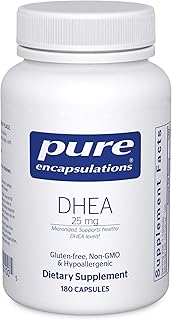
Affiliate disclosure: As an Amazon Associate, this site earns from qualifying purchases linked in this article.
As women navigate the midlife transition known as perimenopause, many bodily changes occur. Hormonal shifts are a hallmark of this period, and while much attention is often given to estrogen and progesterone, other hormones also play significant roles.
Among these are the adrenal androgens, particularly dehydroepiandrosterone (DHEA) and its sulfated form, DHEA-S. Understanding the trajectory of DHEA levels during perimenopause can offer insights into the broader hormonal landscape of this life stage.
What is DHEA and Where Does it Come From?
Dehydroepiandrosterone (DHEA) is a steroid hormone produced primarily by the adrenal glands. It serves as a precursor to other hormones, including androgens and estrogens [1][2]. While the adrenal glands are the main source, other tissues, such as the ovaries, also contribute to DHEA production, though to a lesser extent [3].
DHEA is often discussed in its sulfated form, DHEA-S, which is the most abundant circulating steroid hormone in the human body [1]. DHEA-S has a longer half-life than DHEA, making it a more stable and commonly measured indicator of adrenal androgen production [1].
The Natural Decline of DHEA Levels with Age
DHEA levels naturally peak in early adulthood, typically between the ages of 20 and 30 [1][4]. Following this peak, a gradual and progressive decline in DHEA and DHEA-S concentrations occurs with age, a phenomenon sometimes referred to as ‘adrenopause’ [1][4]. By the age of 80, DHEA-S levels may be only 10-20% of what they were in young adults [4].

This age-related decline is not exclusive to women; men also experience a similar reduction in DHEA-S levels over time [4]. This consistent pattern suggests that the aging process itself is a primary driver of falling DHEA levels.
DHEA Levels and the Perimenopausal Transition
While the general age-related decline of DHEA is well-established, research specifically examining DHEA levels during the perimenopausal transition provides more nuanced insights. Studies have indicated that DHEA-S concentrations continue to decrease throughout the menopausal transition [5][6]. This decline appears to be independent of the ovarian changes that characterize perimenopause and menopause, suggesting it is primarily driven by adrenal gland function and overall aging rather than ovarian senescence [3][6].
One study observed a significant decrease in DHEA-S levels across the menopausal transition stages, with the lowest levels found in the late postmenopausal period compared to early perimenopause [6]. This reinforces the understanding that the adrenal glands’ output of DHEA diminishes progressively as women age through midlife.
What the Decline in DHEA May Signify
The decline in DHEA levels during perimenopause and beyond is a natural part of aging and reflects changes in adrenal function [3]. Given DHEA’s role as a precursor to other sex hormones, its reduction means there is less substrate available for the body to convert into estrogens and androgens [2].
The implications of lower DHEA levels are an area of ongoing research. Some studies have explored potential associations between DHEA levels and various aspects of health. For example, lower adrenal androgen levels, including DHEA, have been investigated in relation to cognitive function and memory circuitry decline in early midlife [7].
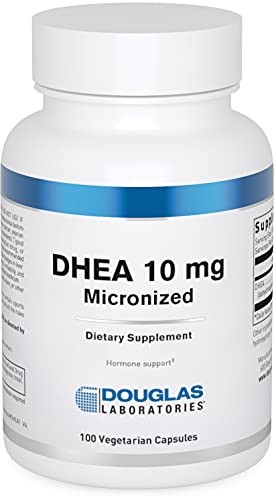
It’s important to understand that the age-related decline in DHEA is a physiological process, not necessarily a deficiency state in all individuals [8]. While DHEA has been explored for various purposes, its role as a precursor hormone means its effects are broad and complex, influencing numerous bodily systems [2].
DHEA and Menopausal Symptoms
The decline in ovarian hormone production, particularly estrogen, is the primary driver of many common menopausal symptoms [9]. While DHEA levels also decline, this decrease is distinct from the ovarian changes. However, DHEA can be converted into sex steroids, including estrogens and androgens, in various peripheral tissues [9]. This local conversion might play a role in buffering some of the effects of declining ovarian hormones, though this is not a substitute for ovarian estrogen production.
Research into the potential utility of DHEA for supporting women through menopause has explored its influence on bone mineral density, sexual function, and vaginal atrophy [9][8]. The mechanisms are believed to involve the local conversion of DHEA into active sex steroids within target tissues [9].

References
- Dehydroepiandrosterone sulfate and postmenopausal women. Current opinion in endocrinology, diabetes, and obesity, 2011
- Dehydroepiandrosterone replacement therapy. Seminars in reproductive medicine, 2004
- Adrenal androgens and the menopausal transition. Obstetrics and gynecology clinics of North America, 2011
- Endocrinology of the aging male. Best practice & research. Clinical endocrinology & metabolism, 2011
- Circulating dehydroepiandrosterone sulfate concentrations during the menopausal transition. The Journal of clinical endocrinology and metabolism, 2009
- Menopausal transition stage-specific changes in circulating adrenal androgens. Menopause (New York, N.Y.), 2012
- Impact of adrenal hormones, reproductive aging, and major depression on memory circuitry decline in early midlife. Brain research, 2019
- Should Dehydroepiandrosterone Be Administered to Women?. The Journal of clinical endocrinology and metabolism, 2022
- DHEA for postmenopausal women: a review of the evidence. Maturitas, 2010
These statements have not been evaluated by the Food and Drug Administration. This information is not intended to diagnose, treat, cure, or prevent any disease. Content is for informational purposes only and is not medical advice; consult a qualified healthcare provider before starting any supplement. As an Amazon Associate we earn from qualifying purchases.