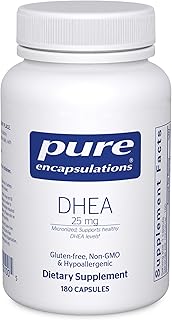
Affiliate disclosure: As an Amazon Associate, this site earns from qualifying purchases linked in this article.
Cycling, taking a supplement for a set period, then stopping for a period, is a common practice with hormone-adjacent products, and DHEA gets grouped into that conversation often. The honest answer is that the rationale is plausible but the direct evidence for DHEA specifically is thin.
The Theoretical Case for Cycling
DHEA is a steroid hormone precursor that the body converts into androgens and estrogens in peripheral tissue[1]. Because hormone systems operate on feedback loops, continuous external input can in theory blunt the body’s own signaling over time, the same logic used to justify cycling with other hormone-adjacent compounds. Proponents of cycling argue it gives the adrenal glands a periodic reset and lets a person re-check their baseline DHEA-S level without supplementation in the picture.
What the Evidence Actually Shows
There is no dedicated randomized controlled trial demonstrating that DHEA tolerance develops with continuous daily use, or that cycling on and off improves outcomes compared to steady dosing. The dosage guidance that does exist, including condition-specific titration protocols, is built around gradually increasing to an effective dose and monitoring labs over time, not stopping and restarting on a fixed schedule[2]. That’s a meaningfully different framework from a bodybuilding-style on/off cycle.

Where Cycling Logic Doesn’t Transfer
Compounds like creatine or vitamin D are sometimes cycled out of habit even though there’s no tolerance mechanism that justifies it. DHEA is different in that it genuinely operates through hormone feedback systems, so the concern isn’t baseless, it’s just untested specifically for DHEA at OTC-supplement doses. Mayo Clinic’s guidance doesn’t address cycling directly, it instead frames the core caution around dose and duration overall, particularly for anyone with hormone-sensitive conditions[1].
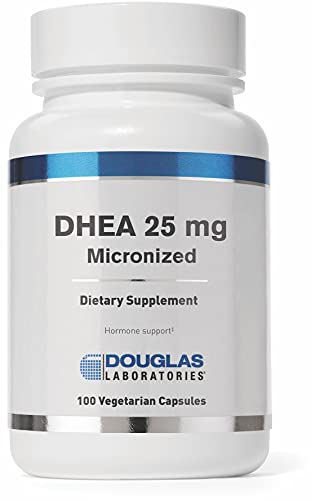
A Practical Middle Ground
Rather than an arbitrary on/off calendar, a more defensible approach is lab-driven: test DHEA-S before starting, use the lowest effective dose, and periodically retest, adjusting or pausing based on what the numbers and symptoms actually show, not a fixed number of weeks on and off[2]. For someone using DHEA under a physician’s supervision for a specific indication, whether or how to cycle is a question for that provider, since it depends on the condition being treated and the dose involved.

What the Longest Trials Did Instead of Cycling
The most useful evidence on this question is indirect, and it comes from what the longest placebo-controlled DHEA trials chose to do. The DHEAge study gave 50 mg of oral DHEA daily to 280 healthy men and women aged 60 to 79 for a full year, with no scheduled washout, and reported no potentially harmful accumulation of DHEA-S or of the active steroids downstream of it[3]. A two-year trial went further, dosing 87 elderly men and 57 elderly women continuously and reporting no major adverse effects from either DHEA or low-dose testosterone over the full period[4].

Neither study built in a break, and neither reported the kind of drift you would expect if continuous dosing were progressively blunting the body’s own output. That is not proof that cycling is pointless, because neither trial was designed to test cycling. It does mean the best long-duration safety data available describes uninterrupted daily use, which is a genuinely awkward fact for the cycling case.
What a Break Actually Measures
There is one thing a pause does reliably, and it is worth separating from the tolerance argument: it lets you see your own unsupplemented number again. Because DHEA-S is the stable, long-lived circulating pool, a DHEA-S drawn while you are still taking a daily dose tells you about your production plus your intake combined. It cannot tell you what your adrenals are doing on their own.
If the actual question is “do I still need this dose, or has something changed?”, then a deliberate pause of several weeks followed by a repeat DHEA-S is a real answer to a real question. That is a diagnostic pause with a defined purpose, which is a different thing from a four-weeks-on, four-weeks-off calendar adopted because that is how people cycle other compounds.
When a Planned Pause Is Genuinely Reasonable
There are a few situations where stopping is straightforwardly sensible rather than speculative. If androgenic side effects appear, acne, oily skin, or unwanted hair growth, reducing or stopping is the standard response and these effects are usually dose-dependent and reversible. If a clinician has ordered hormone testing and needs a clean baseline, a washout is part of the test protocol. And if a hormone-sensitive condition is being investigated, the caution around dose and duration applies regardless of what the schedule looks like[1].
What none of those have in common with bodybuilding-style cycling is that each has a specific reason attached to it. That is the distinction worth holding onto.
The Honest Bottom Line
Cycling DHEA is neither proven necessary nor proven harmful, because the question has not been directly tested. The rationale rests on an analogy to other hormone-adjacent compounds rather than on DHEA-specific data, and the dosing frameworks that do exist are built around titration and lab monitoring rather than fixed on and off blocks[2]. Someone who wants a defensible schedule is better served by deciding in advance what number or symptom would make them change the dose, and then actually checking it, than by picking a calendar and trusting it.
References
- DHEA. Mayo Clinic
- Dehydroepiandrosterone Uses, Benefits & Dosage. Drugs.com
- Dehydroepiandrosterone (DHEA), DHEA sulfate, and aging: contribution of the DHEAge Study to a sociobiomedical issue. Proceedings of the National Academy of Sciences, 2000
- DHEA in elderly women and DHEA or testosterone in elderly men. The New England Journal of Medicine, 2006
These statements have not been evaluated by the Food and Drug Administration. This information is not intended to diagnose, treat, cure, or prevent any disease. Content is for informational purposes only and is not medical advice; consult a qualified healthcare provider before starting any supplement. As an Amazon Associate we earn from qualifying purchases.