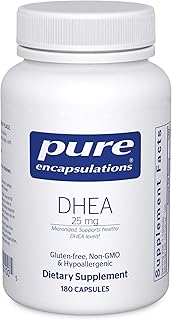
Affiliate disclosure: As an Amazon Associate, this site earns from qualifying purchases linked in this article.
Navigating health decisions during midlife and menopause often involves considering various supplements alongside prescription medications. Dehydroepiandrosterone (DHEA) is one such supplement that warrants careful attention, particularly regarding its potential interactions with other drugs.
Understanding how DHEA might interact with your current prescriptions is crucial for maintaining your well-being. This article will explore key areas of DHEA drug interactions, offering evidence-based information to help you make informed choices in consultation with your healthcare provider.
How DHEA Influences Hormone Pathways
DHEA is a naturally occurring steroid hormone produced by the adrenal glands. It serves as a precursor to other hormones, including androgens and estrogens [1]. This conversion process involves several enzymes within the body, such as cytochrome P450 17A1 (CYP17A1) [2][3] and cytochrome P450 3A7 (CYP3A7) [4].
Because DHEA can impact the levels of other hormones, its use may have implications for individuals taking medications that also influence hormone balance or are metabolized by similar enzymatic pathways. The body’s steroidogenic enzymes play a significant role in this intricate process [5].

DHEA and Hormonal Medications
Given DHEA’s role as a precursor to sex hormones, it is logical to consider its potential interactions with other hormonal therapies. This includes menopausal hormone therapy (MHT), which aims to manage symptoms associated with declining hormone levels during menopause [6].

The combined effect of DHEA and MHT on hormone levels and related physiological systems, such as cardiovascular autonomic control, is an area that warrants attention [6]. Similarly, medications that act as selective estrogen receptor modulators (SERMs) or other reproductive hormones can affect mood during menopause, and adding DHEA might introduce additional considerations [7].
Impact on Cytochrome P450 Enzymes and Drug Metabolism
Many prescription medications are metabolized by a group of enzymes in the liver known as cytochrome P450 (CYP) enzymes. As mentioned, DHEA and its metabolites are involved with specific CYP enzymes, such as CYP17A1 and CYP3A7 [2][4].
This interaction means that DHEA could potentially influence the effectiveness or breakdown rate of certain drugs that are also metabolized by these same enzymes. If DHEA affects the activity of these enzymes, it could theoretically alter how your body processes other medications, potentially leading to higher or lower levels of those drugs in your system. For example, the interaction between human cytochrome P450 17A1 and its substrates is a complex process [2][3].

While specific drug-DHEA interactions via these pathways require individual assessment, understanding this general mechanism is important. For instance, traditional Chinese medicine formulations like Erchen Decoction have been studied for their effects on steroid biosynthesis pathways, indicating the broad impact on these systems [8].
Considerations for Mental Health Medications
The intricate relationship between hormones and mood is well-documented, especially during the menopause transition. Reproductive hormones and selective estrogen receptor modulators can influence mood during menopause [7].

Given DHEA’s role in hormone synthesis, it’s prudent to consider its potential impact when individuals are taking medications for mood or mental health conditions. Any changes in hormone levels could theoretically influence the efficacy or side effects of these medications, necessitating careful monitoring and discussion with a healthcare provider.
Specific Populations and Medications
Certain health conditions and their associated medications might present unique interaction considerations with DHEA. For example, research has explored correlates of white matter features in older men and women living with human immunodeficiency virus (HIV) [9]. While this specific study doesn’t directly address DHEA interactions, it highlights the importance of considering complex health profiles when evaluating supplement use.
It is always important to disclose all supplements you are taking, including DHEA, to your healthcare team, especially if you have chronic health conditions or are on long-term medication regimens.
References
- Androgen synthesis in adrenarche. Reviews in endocrine & metabolic disorders, 2009
- Insights into Interactions of Human Cytochrome P450 17A1: A Review. Current drug metabolism, 2022
- Tracking protein-protein interactions by NMR: conformational selection in human steroidogenic cytochrome P450 CYP17A1 induced by cytochrome b(5). Physical chemistry chemical physics : PCCP, 2024
- Human cytochrome P450 3A7 binding four copies of its native substrate dehydroepiandrosterone 3-sulfate. The Journal of biological chemistry, 2023
- Steroidogenic enzymes. Endocrine development, 2008
- Interaction between cardiovascular autonomic control and sex hormones in perimenopausal women under menopausal hormone therapy. Cardiovascular endocrinology & metabolism, 2018
- Effect of reproductive hormones and selective estrogen receptor modulators on mood during menopause. Drugs & aging, 2003
- Erchen Decoction ameliorates the rat model of polycystic ovary syndrome by regulating the steroid biosynthesis pathway. Phytomedicine : international journal of phytotherapy and phytopharmacology, 2025
- Do correlates of white matter features differ between older men and women living with human immunodeficiency virus?. Menopause (New York, N.Y.), 2023
These statements have not been evaluated by the Food and Drug Administration. This information is not intended to diagnose, treat, cure, or prevent any disease. Content is for informational purposes only and is not medical advice; consult a qualified healthcare provider before starting any supplement. As an Amazon Associate we earn from qualifying purchases.