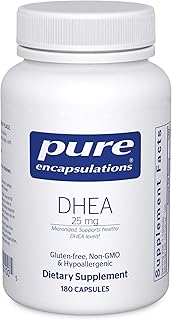
Affiliate disclosure: As an Amazon Associate, this site earns from qualifying purchases linked in this article.
Dehydroepiandrosterone (DHEA) is a naturally occurring steroid hormone that the body produces. It serves as a precursor to other hormones, including estrogens and androgens. As women navigate midlife and menopause, DHEA levels naturally decline, leading some to consider DHEA supplementation.
Understanding the DHEA dosage for women used in clinical trials is crucial for those seeking information about its potential applications. This article explores the various doses of DHEA that have been investigated in research settings, particularly for concerns relevant to women in midlife and menopause.
Understanding DHEA and Its Role
DHEA is produced primarily by the adrenal glands, with smaller amounts made by the gonads and brain. It is considered a ‘prohormone’ because it can be converted into more potent hormones like testosterone and estradiol within the body’s tissues. This conversion process is complex and can vary among individuals and tissues, which may influence the effects observed with supplementation.
The interest in DHEA supplementation often stems from its decline with age. Research has explored whether restoring DHEA levels might offer benefits for various age-related changes, including those associated with menopause. However, it’s important to recognize that DHEA’s effects are not always straightforward and can depend on individual metabolism and the specific tissues where it is converted.
DHEA Dosage for Vaginal Health and Genitourinary Syndrome of Menopause (GSM)
One area where DHEA dosage for women has been extensively studied is in the context of genitourinary syndrome of menopause (GSM), formerly known as vulvovaginal atrophy. This condition involves changes to the vulva, vagina, and lower urinary tract due to declining estrogen levels, leading to symptoms like vaginal dryness, irritation, and painful intercourse.
Intravaginal DHEA, specifically in the form of prasterone, has been approved for the management of moderate to severe painful intercourse (dyspareunia) due to GSM [1]. Clinical trials have commonly used a DHEA dosage of 0.5% prasterone in a vaginal insert, administered daily [2][3]. This localized application aims to deliver DHEA directly to vaginal tissues, where it can be converted to estrogens and androgens, potentially improving symptoms with minimal systemic absorption. Studies have indicated that this specific dosage and delivery method can be effective for improving various aspects of GSM, including dyspareunia [2][3].

Oral DHEA Dosage and Hormonal Levels
Beyond localized application, oral DHEA supplementation has been investigated for its systemic effects. The DHEA dosage for women in oral forms varies considerably in research. A meta-analysis examining the effect of DHEA supplementation on estradiol levels in women found that doses ranging from 25 mg to 100 mg per day were used in randomized clinical trials. This analysis suggested a dose-dependent increase in estradiol levels with DHEA supplementation [4].

Another meta-analysis focused on the impact of DHEA supplementation on testosterone levels. It included studies with DHEA dosages for women ranging from 25 mg to 100 mg per day and concluded that DHEA supplementation can increase testosterone levels in women in a dose-dependent manner [5]. These findings highlight that oral DHEA can influence the levels of other sex hormones, which may have broader implications for women’s health.
It’s important to note that while these studies suggest a dose-response relationship for hormonal changes, the optimal DHEA dosage for women to achieve specific health outcomes without unwanted side effects is not definitively established for all conditions. The conversion of DHEA to other hormones can be influenced by individual factors, and systemic hormonal changes may not always be desirable or beneficial for every woman.
DHEA Dosage in Fertility Research
In the realm of reproductive health, DHEA has been explored as an adjuvant therapy, particularly for women with diminished ovarian reserve (DOR) undergoing in vitro fertilization (IVF). Systematic reviews and meta-analyses have investigated the role of DHEA in this context. While the evidence is still developing, some studies have looked at DHEA dosages for women with DOR.

For instance, one systematic review and meta-analysis of randomized controlled trials on therapeutic management in women with DOR included studies where DHEA was used [6]. Another systematic review and network meta-analysis on adjuvant treatment strategies in ovarian stimulation for poor responders undergoing IVF also considered DHEA [7]. While specific dosages can vary across individual trials, typical oral DHEA dosages for women in fertility studies have often ranged from 25 mg to 75 mg per day, typically taken for several weeks or months prior to IVF cycles. The aim is often to potentially improve ovarian response or oocyte quality, though the overall evidence strength for these benefits remains moderate and individual responses can differ [6][7].
It is crucial to understand that DHEA supplementation in the context of fertility is a specialized area and should only be undertaken under strict medical supervision. The potential benefits and risks need to be carefully weighed for each individual.
DHEA Dosage and Metabolic Parameters
Beyond hormonal and reproductive aspects, researchers have also investigated the impact of DHEA supplementation on metabolic parameters. A systematic review and dose-response meta-analysis explored the effects of DHEA supplementation on the lipid profile. This analysis included studies using varying DHEA dosages for women and men, finding that DHEA supplementation did not significantly affect total cholesterol, LDL-cholesterol, or HDL-cholesterol levels [8].

This suggests that, at the dosages typically studied (which included a range), DHEA may not have a pronounced effect on lipid profiles. It is important to consider that metabolic responses can be complex and may be influenced by other factors such as diet and lifestyle, as seen in studies exploring dietary interventions for conditions like polycystic ovary syndrome (PCOS) [9], where vitamin D supplementation has also been studied [10]. Therefore, relying on DHEA alone for metabolic health changes may not be supported by current evidence.

References
- Prasterone. American journal of health-system pharmacy : AJHP : official journal of the American Society of Health-System Pharmacists, 2006
- Hormonal Treatments and Vaginal Moisturizers for Genitourinary Syndrome of Menopause : A Systematic Review. Annals of internal medicine, 2024
- Nonestrogen Therapies for Treatment of Genitourinary Syndrome of Menopause: A Systematic Review. Obstetrics and gynecology, 2023
- The effect of dehydroepiandrosterone (DHEA) supplementation on estradiol levels in women: A dose-response and meta-analysis of randomized clinical trials. Steroids, 2021
- A dose-response and meta-analysis of dehydroepiandrosterone (DHEA) supplementation on testosterone levels: perinatal prediction of randomized clinical trials. Experimental gerontology, 2020
- Therapeutic management in women with a diminished ovarian reserve: a systematic review and meta-analysis of randomized controlled trials. Fertility and sterility, 2025
- Adjuvant treatment strategies in ovarian stimulation for poor responders undergoing IVF: a systematic review and network meta-analysis. Human reproduction update, 2020
- Effects of dehydroepiandrosterone (DHEA) supplementation on the lipid profile: A systematic review and dose-response meta-analysis of randomized controlled trials. Nutrition, metabolism, and cardiovascular diseases : NMCD, 2020
- The effects of portfolio moderate-carbohydrate and ketogenic diets on anthropometric indices, metabolic status, and hormonal levels in overweight or obese women with polycystic ovary syndrome: a randomized controlled trial. Nutrition journal, 2024
- Effects of Vitamin D Supplementation on Surrogate Markers of Fertility in PCOS Women: A Randomized Controlled Trial. Nutrients, 2021
These statements have not been evaluated by the Food and Drug Administration. This information is not intended to diagnose, treat, cure, or prevent any disease. Content is for informational purposes only and is not medical advice; consult a qualified healthcare provider before starting any supplement. As an Amazon Associate we earn from qualifying purchases.