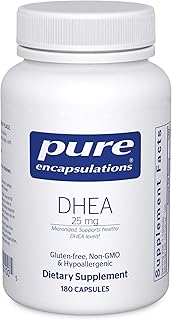
Affiliate disclosure: As an Amazon Associate, this site earns from qualifying purchases linked in this article.
Navigating midlife and menopause often involves exploring various options to support well-being. DHEA (dehydroepiandrosterone) is a naturally occurring steroid hormone precursor produced by the adrenal glands, gonads, and brain. It plays a role in the production of other hormones, including androgens and estrogens, through a process known as intracrinology, where steroid hormones are synthesized and activated within target tissues [1][2].
For women considering DHEA supplementation, particularly those with a history of hormone-sensitive cancers or a family history of such conditions, understanding the potential considerations is crucial. This article provides an evidence-based overview of DHEA in relation to hormone-sensitive cancers, with a focus on DHEA breast cancer risk, to help women make informed decisions in consultation with their healthcare providers.
Understanding DHEA’s Role in Hormone Production
DHEA is often referred to as a ‘prohormone’ because it can be converted into more potent hormones, such as testosterone and estradiol, within various tissues throughout the body [1][2]. This localized conversion, or intracrinology, means that the effects of DHEA can be specific to the tissues where it is metabolized, rather than acting as a direct hormone itself [1]. This complex metabolic pathway is important when considering its potential influence on hormone-sensitive conditions.
The body’s ability to convert DHEA into other steroids can vary among individuals and tissues. This variability suggests that the impact of DHEA supplementation might not be uniform for everyone. The intricate balance of hormone synthesis and metabolism highlights the need for careful consideration, especially concerning conditions influenced by hormone levels.
Breast Cancer and Endogenous Hormones: The Established Link
There is a well-established association between endogenous (naturally produced) sex hormones and breast cancer risk. Studies have consistently shown that higher circulating levels of certain sex steroids are linked to an increased risk of breast cancer in both premenopausal and postmenopausal women. For instance, higher levels of circulating sex steroids have been associated with breast cancer risk in premenopausal women [3]. Similarly, in postmenopausal women, serum sex hormones have been linked to breast cancer risk [4][5].

A comprehensive reanalysis of nine prospective studies indicated an association between endogenous sex hormones and breast cancer in postmenopausal women [5]. Early research also highlighted the role of endogenous hormones in breast cancer risk [6]. These findings underscore the importance of hormone levels in the context of breast cancer development. Given that DHEA can influence the production of these very hormones, its potential impact warrants careful consideration, particularly for individuals with elevated risk factors or a history of breast cancer.

DHEA and Breast Cancer Risk: What the Evidence Suggests
The direct link between DHEA supplementation and breast cancer risk is a significant area of concern for many women. While endogenous DHEA levels themselves have been studied, the impact of exogenous DHEA (from supplements) on breast cancer risk is a complex topic. The concern arises because DHEA can be converted into estrogens, and elevated estrogen levels are a known factor in breast cancer risk [3][4][5].
For women who have experienced breast cancer, managing menopausal symptoms, such as genitourinary syndrome of menopause, is a critical concern. While DHEA has been explored for these symptoms, the safety profile, especially regarding recurrence or new primary cancers, is paramount. The management strategies for genitourinary syndrome of menopause in breast cancer survivors often involve careful consideration of hormonal therapies due to the hormone-sensitive nature of many breast cancers [7]. This highlights the need for individualized assessment and discussion with a healthcare provider regarding any DHEA use in this population.
Considerations for Hormone-Sensitive Cancers Beyond Breast Cancer
While breast cancer is a primary concern when discussing DHEA and hormone-sensitive conditions, other hormone-sensitive cancers may also warrant attention. The broad metabolic pathways of DHEA, leading to the production of various sex steroids, suggest a potential influence on other hormone-dependent tissues. Although the strongest evidence concerns breast cancer, the principle of DHEA’s conversion into potent hormones applies generally.

Therefore, women with a history of any hormone-sensitive cancer, or those with a strong family history, should approach DHEA supplementation with caution. The decision to use DHEA should involve a thorough discussion with a healthcare professional who can assess individual risk factors, medical history, and the potential for DHEA to influence hormone levels relevant to their specific cancer type.
Navigating DHEA Use with a History of Hormone-Sensitive Cancer
For women with a history of hormone-sensitive cancer, or those at high risk, the decision to use DHEA requires careful evaluation by a healthcare provider. The potential for DHEA to be converted into estrogens or androgens within the body means that it could theoretically impact the growth or recurrence of hormone-sensitive cancers [1]. Therefore, DHEA is generally not recommended for individuals with a history of hormone-sensitive cancers unless specifically advised and monitored by a qualified healthcare professional.
Healthcare providers can offer personalized guidance, weighing the potential benefits against the risks based on an individual’s specific medical history, cancer type, and treatment regimen. This often involves a detailed discussion about alternative strategies for managing menopausal symptoms or other health concerns that do not involve substances that could influence hormone levels.

References
- Intracrinology. Molecular and cellular endocrinology, 1991
- Is dehydroepiandrosterone a hormone?. The Journal of endocrinology, 2005
- Circulating sex steroids and breast cancer risk in premenopausal women. Hormones & cancer, 2010
- Body mass index, serum sex hormones, and breast cancer risk in postmenopausal women. Journal of the National Cancer Institute, 2003
- Endogenous sex hormones and breast cancer in postmenopausal women: reanalysis of nine prospective studies. Journal of the National Cancer Institute, 2002
- Endogenous hormones and breast cancer risk. Epidemiologic reviews, 1993
- Management of genitourinary syndrome of menopause in breast cancer survivors: An update. World journal of clinical oncology, 2022
These statements have not been evaluated by the Food and Drug Administration. This information is not intended to diagnose, treat, cure, or prevent any disease. Content is for informational purposes only and is not medical advice; consult a qualified healthcare provider before starting any supplement. As an Amazon Associate we earn from qualifying purchases.