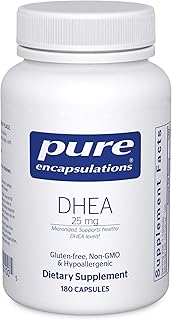
Affiliate disclosure: As an Amazon Associate, this site earns from qualifying purchases linked in this article.
Dehydroepiandrosterone (DHEA) is a steroid hormone produced by the adrenal glands, gonads, and brain. It serves as a precursor to other hormones, including androgens and estrogens, through a process called intracrinology, where DHEA is converted into active hormones within target tissues rather than circulating in high levels [1].
For perimenopausal women considering DHEA, understanding potential contraindications is crucial. While DHEA may be discussed for various aspects of midlife health, certain pre-existing conditions or medical situations may make its use unsuitable or require careful medical oversight. This article explores key DHEA contraindications for women navigating perimenopause.
Hormone-Sensitive Cancers: A Primary Concern
Given DHEA’s role as a precursor to sex hormones like estrogens and androgens [1], there is a significant concern regarding its use in individuals with hormone-sensitive cancers. For instance, some breast cancers are estrogen-receptor positive, meaning their growth can be stimulated by estrogen. Similarly, certain gynecological cancers may also be influenced by hormonal levels.
While the direct impact of DHEA supplementation on cancer recurrence or progression is an area of ongoing research, the potential for DHEA to increase levels of these active hormones within tissues necessitates caution [2]. Therefore, women with a personal history of hormone-sensitive cancers, or those with a strong family history, are generally advised to avoid DHEA or proceed only under stringent medical supervision. This also extends to women undergoing evaluation for suspicious lumps or abnormal mammogram findings.
Androgen-Related Conditions: Polycystic Ovary Syndrome (PCOS) and Androgen Excess
DHEA is a precursor to androgens, often referred to as ‘male hormones,’ although they are naturally present and important in women [3]. Conditions characterized by elevated androgen levels, such as Polycystic Ovary Syndrome (PCOS), represent a potential contraindication for DHEA supplementation. Women with PCOS often experience symptoms like hirsutism (excess body hair), acne, and irregular menstrual cycles, which are linked to androgen excess [4].
Introducing exogenous DHEA could potentially exacerbate these androgen-related symptoms. While DHEA levels can be measured to assess androgen status [4], adding DHEA without careful consideration in women already experiencing androgen excess is generally not recommended. A thorough evaluation of baseline androgen levels and a discussion of individual symptoms are essential before considering DHEA in this population.

Pre-existing Liver Conditions
The liver plays a critical role in metabolizing hormones, including DHEA and its metabolites. While specific studies on DHEA contraindications in severe liver disease are limited, the liver’s involvement in hormone processing suggests that impaired liver function could potentially alter DHEA’s metabolism or the body’s response to supplementation. This could lead to unpredictable hormone levels or place additional strain on an already compromised liver.
Women with significant liver disease, such as cirrhosis or active hepatitis, should approach DHEA supplementation with extreme caution. It is imperative to consult with a healthcare provider who can assess liver function and determine the safety and appropriateness of DHEA in such cases. The potential for altered drug metabolism and increased side effects must be carefully weighed.
Cardiovascular Disease and Blood Clotting Disorders
The relationship between DHEA, sex hormones, and cardiovascular health is complex. While some research explores the potential impact of DHEA on cardiovascular markers, there is not yet a consensus that supports its use for cardiovascular benefit, particularly in individuals with pre-existing heart conditions. Hormonal fluctuations, including those influenced by DHEA, can have various effects on the cardiovascular system.
For women with a history of cardiovascular disease, including heart attack, stroke, or blood clotting disorders, the decision to use DHEA requires careful consideration. While DHEA is not directly linked to increased clotting risk in the same way as some synthetic estrogens, the broader hormonal changes it induces warrant caution. Any potential hormonal therapy, including DHEA, should be discussed thoroughly with a cardiologist or a healthcare provider familiar with the individual’s cardiovascular history to assess any theoretical risks.

Adrenal Insufficiency and Other Endocrine Disorders
DHEA is primarily produced by the adrenal glands [5]. In conditions like adrenal insufficiency, where the adrenal glands do not produce enough hormones, the body’s entire hormonal balance can be disrupted [5]. While DHEA supplementation might seem intuitively helpful in such cases, the management of adrenal insufficiency is highly specialized and typically involves specific corticosteroid replacement therapies [5].
Introducing DHEA without careful endocrine evaluation and management could interfere with established treatment protocols or mask underlying issues. Therefore, women with diagnosed adrenal insufficiency or other complex endocrine disorders should only consider DHEA under the direct guidance of an endocrinologist. The intricate interplay of hormones requires expert assessment to avoid unintended consequences.
Known Hypersensitivity or Allergic Reactions
While rare, any individual can develop a hypersensitivity or allergic reaction to a supplement or medication. If a woman has previously experienced an allergic reaction to DHEA or any of its inactive ingredients, its use is contraindicated. Symptoms of an allergic reaction can range from skin rashes and itching to more severe reactions like swelling or difficulty breathing.
It is important to review the full list of ingredients in any DHEA product, especially if there are known allergies to excipients or fillers. Any signs of an allergic reaction should prompt immediate discontinuation of DHEA and medical attention.


References
- Intracrinology. Molecular and cellular endocrinology, 1991
- Dehydroepiandrosterone, Cancer, and Aging. Aging and disease, 2022
- Androgen production in women. Fertility and sterility, 2002
- Evaluating the diagnostic accuracy of androgen measurement in polycystic ovary syndrome: a systematic review and diagnostic meta-analysis to inform evidence-based guidelines. Human reproduction update, 2025
- Adrenal Insufficiency in Adults: A Review. JAMA, 2025
These statements have not been evaluated by the Food and Drug Administration. This information is not intended to diagnose, treat, cure, or prevent any disease. Content is for informational purposes only and is not medical advice; consult a qualified healthcare provider before starting any supplement. As an Amazon Associate we earn from qualifying purchases.